


Accruent Data Insights
About the project
We had a vision for how to leverage the vast medical equipment data interminably stored within Accruent's vast enterprise software in a way that would provide indispensable value to our customers and greatly enhance our healthcare product offering.
His idea was fast-tracked to become part of the Fortive Growth Accelerator. This was a special 10+ week program where a small team was chosen to participate in a product development sprint piloted by experts from The Lean Startup Co. and founder Eric Ries.
My role
The team was dubbed "Medasights" and was comprised of the Director as the team lead, a product manager, a data engineer, healthcare industry SVP, and myself as user experience designer.
Over the next several weeks we traveled to Seattle, Washington with five other Fortive op-co’s to learn from the Lean Startup Co. and participate in trainings, competitions, experiments, and team building activities through this guided product development program.
Working hypotheses
These took shape from the months of market research and data collected by our team lead at the inception, and then refined by the team after careful analysis.
We arrived at the following 4 central hypotheses:
-
Our software holds data that our healthcare customers value and would pay to have access to.
-
We can help our customers select the right medical equipment to provide the best care for patients utilizing asset reliability insights.
-
We can help customers reduce or optimize capital investment.
-
We can help customers reduce planned maintenance and increase healthcare facility availability.
Discovery pre-project kickoff
With the launch week in Seattle soon approaching, we had work to do now that we had our testable hypotheses. This next phase focused around further identifying and understanding the problem, defining solid use cases, and cultivating target personas.
Building off of our team lead's initial research, we did a deep dive exploration into the market to identify and analyze potential competitors. Then we focused on speaking with industry experts, a chief of medicine, clinical engineers, hospital facility administrators, and financial decision makers who were willing to participate in the experiments and lend their expertise and time.
Some research highlights:
- 200 targeted surveys with a 70% response rate to key healthcare professionals
- Consulted with 19 healthcare industry experts
- Conducted three or more 1-hour session interviews with 20 existing customers and 3 potential customers
- Gathered data for persona building
Our personas emerged from a synthesis of the dozens of people we'd been in daily conversations with. We were now able to organize and empathize with the following user profiles whose problems we wanted to solve in a more comprehensible way.


Ideation, design, and testing
It was finally time for the kickoff week at the Seattle headquarters, where most of our team would see each other in person for the first time (we were coming together from Austin, London, Minneapolis, and San Francisco). This was also where we were introduced to the other 5 teams and the Lean Startup Co. experts and Fortive executives who would be leading this special program.
We capitalized on the tools and framework we learned from and were guided by the Lean Startup Co. as we analyzed our research and sought to validate assumptions. This phase focused on team collaboration as we participated in trainings, competitions, experiments, and more activities centered around product development.
We worked together to validate our value proposition definition and diligently complete strategy and vision worksheets/canvasses before we moved to sketching out ideas and determining metrics and KPIs for success.
The below are some examples of these exercises (blurred for proprietary reasons).


Now that we had thoroughly defined our problem and set the stage for informed idea generation, we started collaborating on solutions. We spent a large amount of our time in-person and then continuing on through Slack and Invision to have whiteboarding sessions, user journey mapping, writing user stories, and creating early sketches.

Left image: screenshot of an unintelligible report generated by our existing software
Right image: back-of-a-napkin sketch of how to display this slew of data in a meaningful way
Getting incremental feedback from our industry contacts as we went through the wireframe process was critical here. We continuously iterated on the designs, and ran several tests to find how we could leverage our existing clunky and enormous data set to actually provide value to customers.


Once we had an idea of what we wanted the design to look like and how to display what information where, we tested this out in a series of Lean Startup Co. guided experiments.
An example of one of the most scrappy experiments we ran was that where we'd discover what a particular customer was about to make a decision about, and then we would generate a specific equipment report for them for free from the data in our existing software (pictured to the left above.) Then I'd create a mock report using my wireframes in Sketch and export to pdf and deliver to the customer (ex pictured above right). Armed with this new report, the goal was to validate whether it would be actually useful and relevant to a customer in making an actual financial decision for their hospital in the real world.
Experiment results:
-
19 of 20 indicated in interviews that reliability data would be useful in their procurement cycle.
-
17 of 20 requested a report for their next cycle
-
20 of 20 downloaded/reviewed the report
-
19 of 20 shared the report with others in their org
-
15 of 20 used the report in their decision making process
-
7 of 20 are willing to give a testimonial
-
12 of 20 have signed a LOI
Launch and beyond
With our data visualization reports' value validated by customers, I designed the high-fidelity workflows and designs with dozens of screens* that we tested all the way through as the engineers started the front-end work.
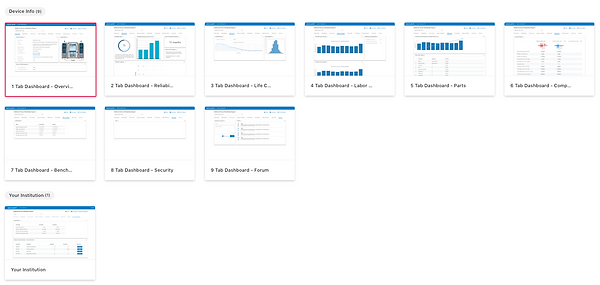

As the PD sprint wrapped up, we launched our new product and went live with our new paying customers!
The Growth Accelerator product development sprint was a decisive success, and heavy support for the expansion of this program was garnered. The Medasights team received notable recognition from Fortive as the best team with the winning product of the PD competition, and we earned significant investment increase into the continuation of the new product.
At this point of the journey, I was needed on other projects with other Accruent products and so I had the responsibility of getting another designer ramped up and ready to take on the rest of Medasights as work on the product continued.
The product was recently rebranded as Accruent Data Insights and continues to be a cutting-edge market differentiator. Our little team delivered on our hypotheses, and the product continues to evolve.
We are now able to say with confidence that our software holds data that our healthcare customers value and pay to have access to, and we do the following and strive for even more:
-
Improves the Quality of Patient Care
-
Improves your patients' healthcare outcomes with higher uptime and better performing equipment
-
-
Make the Right Purchasing Decisions
-
Compare potential new devices to thousands of competing options and make the most reliable, cost-effective choices
-
-
Repair, Replace, and Decomission With Ease
-
Analyze total cost of ownership, asset performance estimated lifespan, and other asset details to make informed decisions
-
-
Stretch Tight Budgets Over Time
-
Eliminating unnecessary maintenance and unplanned downtime can improve maintenance processes and lower asset costs
-


